Section 179 of the Internal Revenue Code allows qualifying businesses to deduct eligible equipment expenses, including certain business vehicles, in the tax year the property is placed into service. Rather than recovering the entire cost through depreciation over several years, eligible businesses may claim an accelerated federal tax deduction, subject to applicable IRS requirements and limitations.
For business owners in Southern California, purchasing or financing an eligible Mercedes-Benz SUV or Sprinter Van may provide opportunities for federal tax deductions in 2026. Certain luxury SUVs with a Gross Vehicle Weight Rating (GVWR) exceeding 6,000 pounds may qualify for specialized Section 179 treatment and additional depreciation benefits.
Explore our qualifying Section 179 Mercedes-Benz inventory to discover available vehicles for your business.
For tax years beginning in 2026, the IRS allows an overall Section 179 deduction of up to $2,560,000 for qualifying business property. This maximum begins to phase out when the total cost of eligible property placed into service during the tax year exceeds $4,090,000. The deduction is fully phased out at $6,650,000 in qualifying property acquisitions.
Special rules apply to qualifying heavy SUVs. For 2026, the Section 179 deduction for certain passenger-oriented SUVs weighing more than 6,000 pounds and no more than 14,000 pounds GVWR is limited to $32,000. Additional federal depreciation may be available for the remaining eligible business-use basis.
To qualify for Section 179, a vehicle generally must be acquired and placed into service during the applicable tax year, with more than 50% qualified business use. The deduction is also subject to taxable business income limitations and other requirements.
Explore current opportunities on select Mercedes-Benz vehicles that may meet Section 179 requirements. Vehicle eligibility and applicable tax treatment depend on the specific vehicle and your business circumstances.

Purchase before year’s end and your business may qualify to deduct up to $32,000 through Section 179 and/or up to 100% of the purchase price through Section 168(k)**
*$6,720 tax savings based on 21% federal corporate tax rate and eligibility to claim full $32,000 IRS Section 179 tax deduction for qualified vehicles. Your tax rate and eligibility may vary. Please consult a tax professional for more information on your federal tax rate and potential savings available to you for qualifying purchases. This information does not constitute, nor is it intended to be, legal, tax, financial planning or investment advice and should not be relied upon as such. $32,000 tax deduction for qualifying vehicles based on current Section 179 of U.S. tax code and maximum deduction permitted for such vehicles under Section 179. Vehicle must be purchased for business use. Please consult your tax advisor.
**Tax incentives, including Section 179 and Section 168(k), may be available for qualifying vehicles. Taxpayers may be entitled to U.S. federal income tax deductions and/or credits for purchases of vehicles that are placed in service in a trade or business during 2026. Determining the proper income tax treatment of any vehicle purchase requires careful consideration of several factors including, but not limited to, the applicable laws, regulations, and guidelines, the characteristics and attributes of the particular vehicle purchased and the purchaser’s income tax situation. Each purchaser’s tax situation is unique and the available tax benefits and the applicable federal tax laws, regulations and guidelines are subject to change without notice. Therefore, customers must consult their tax advisor to determine the proper tax treatment of any vehicle purchase(s). For more information, visit www.irs.gov. This information does not constitute, nor is it intended to be, legal, tax, financial planning or investment advice and should not be relied upon as such.
Federal depreciation rules vary depending on a vehicle’s classification, manufacturer-rated GVWR, seating and cargo configuration, and qualifying business use.
Qualifying heavy SUVs are generally subject to a $32,000 Section 179 deduction limit for 2026. Eligible vehicles may also qualify for 100% bonus depreciation on the remaining depreciable business-use basis, subject to applicable IRS rules.
Potential Mercedes-Benz candidates include select configurations of the GLE SUV, GLS SUV, G-Class SUV, EQE SUV, and EQS SUV. Eligibility must be confirmed using the specific vehicle’s manufacturer-rated GVWR and applicable tax classifications.
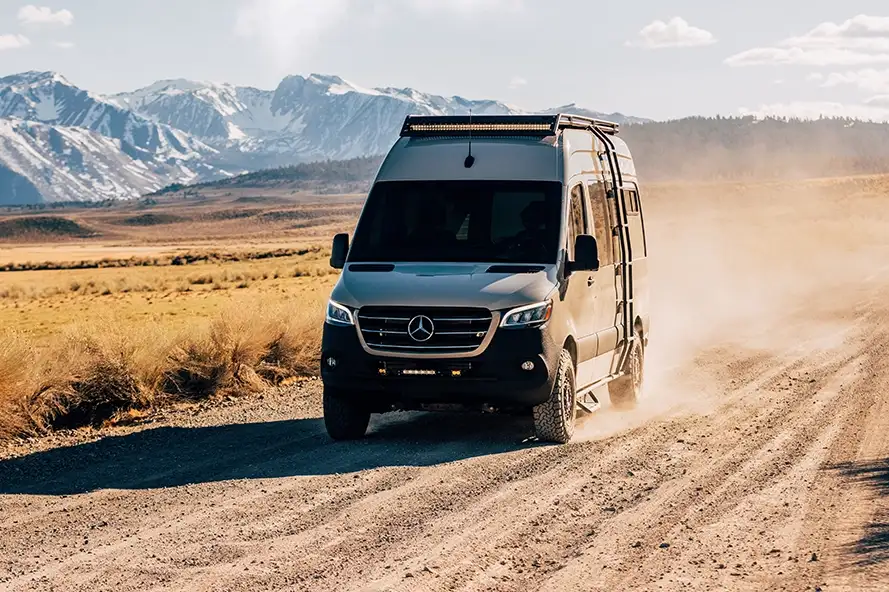
Certain commercial vehicles may qualify for different Section 179 treatment, including vehicles meeting specified seating, cargo-area, or design requirements. Eligible Mercedes-Benz Sprinter Vans may qualify for Section 179 expensing without being subject to the special $32,000 heavy-SUV limit.
For 2026, qualifying commercial vehicles may be eligible for Section 179 deductions within the overall $2,560,000 federal limit, subject to business income, business use, property acquisition requirements, and other applicable restrictions.
Passenger automobiles subject to IRS Section 280F depreciation limits have more restrictive first-year deduction allowances. For qualifying passenger automobiles placed into service during calendar year 2026, the maximum first-year federal depreciation deduction is generally $20,300 when bonus depreciation applies or $12,300 when bonus depreciation does not apply, assuming 100% qualifying business use and subject to other limitations.
These limits include applicable Section 179 and depreciation deductions and are adjusted for business-use percentage. They generally apply to passenger vehicles subject to the statutory automobile depreciation rules.
Yes. Under current federal tax law, 100% bonus depreciation is available for eligible property acquired after January 19, 2025, and placed into service in accordance with applicable IRS requirements.
For a qualifying Mercedes-Benz SUV exceeding 6,000 pounds GVWR, eligible businesses may be able to claim a Section 179 deduction of up to $32,000 and apply 100% bonus depreciation to the remaining eligible business-use basis. Depending on the vehicle and business circumstances, this may permit a first-year federal deduction exceeding the $32,000 Section 179 SUV limitation.
Bonus depreciation is separate from Section 179, and the two provisions have different eligibility rules and limitations. The availability and amount of the deduction depend on the vehicle’s classification, acquisition date, placed-in-service date, business-use percentage, and other factors.
Gross Vehicle Weight Rating (GVWR) is the maximum allowable operating weight assigned by the vehicle manufacturer. It includes the vehicle itself, passengers, cargo, and other allowable loads.
GVWR is not the same as curb weight. For certain federal heavy-SUV depreciation provisions, the relevant threshold is a manufacturer-rated GVWR greater than 6,000 pounds and not exceeding 14,000 pounds.
To verify your Mercedes-Benz vehicle’s GVWR, review the following sources:
The specific vehicle’s GVWR and classification must be confirmed before determining potential tax eligibility.
Several Mercedes-Benz SUV and commercial van model families offer configurations that may satisfy the GVWR requirements associated with Section 179. The following vehicles are potential candidates, although eligibility varies by model year, trim, configuration, and specific vehicle.
Not every configuration within these model families meets the heavy-vehicle requirements. Vehicle GVWR and federal tax classification must be verified individually. Certain commercial vans may qualify under provisions different from those applicable to passenger-oriented SUVs.
Explore our available qualifying Section 179 Mercedes-Benz vehicles or browse our new Mercedes-Benz SUV inventory.
A qualifying limited liability company (LLC) may be able to claim Section 179 deductions for eligible business vehicles. The appropriate tax treatment depends on the LLC’s federal tax classification, the vehicle’s ownership, how the vehicle is used, and other applicable requirements.
Business owners considering Section 179 should generally review the following steps with their tax professionals:
Yes. California does not fully conform to federal Section 179 expensing limits or federal bonus depreciation provisions. Although federal law provides a maximum Section 179 deduction of $2,560,000 for tax years beginning in 2026, California generally maintains a substantially smaller Section 179 deduction limit of $25,000, with a separate phaseout threshold.
California also does not conform to the federal 100% bonus depreciation provision under Section 168(k). As a result, an eligible Mercedes-Benz business vehicle may receive different depreciation treatment on federal and California income tax returns.
Business owners in Laguna Niguel and throughout Southern California should consult their tax advisors to understand how federal and California tax requirements apply to their circumstances.
The federal Section 179 deduction limit for qualifying heavy SUVs subject to the special SUV limitation is $32,000 for tax years beginning in 2026. Additional depreciation may be available on the remaining eligible business-use basis.
Potentially. Certain qualifying heavy SUVs may be eligible for a combination of Section 179 expensing and 100% federal bonus depreciation. Depending on the taxpayer’s circumstances, this may permit deduction of the full eligible business-use basis during the first year. Qualification is not automatic, and applicable restrictions must be considered.
No. For Section 179 eligibility, qualified business use generally must exceed 50%. If a vehicle is used for both business and personal purposes, deductions are generally calculated using the qualifying business-use percentage. Commuting between home and a regular workplace generally does not count as business mileage.
Yes. A qualifying vehicle acquired through a financing arrangement may be eligible for Section 179, provided applicable ownership, business-use, and placed-in-service requirements are met. A conventional vehicle lease generally receives different tax treatment.
Yes. Certain pre-owned vehicles may qualify for Section 179 and bonus depreciation when applicable acquisition, ownership, business-use, and eligibility requirements are satisfied. Explore our pre-owned Mercedes-Benz inventory for additional options.
For a calendar-year taxpayer seeking a 2026 deduction, an eligible vehicle generally must be acquired and placed into service by December 31, 2026. The placed-in-service date is when the vehicle is ready and available for its intended business use, not necessarily the date a purchase agreement is signed. Different timing considerations may apply to fiscal-year taxpayers.
Mercedes-Benz of Laguna Niguel offers a selection of vehicles that may meet applicable Section 179 requirements. Visit our Section 179 vehicle inventory to explore available Mercedes-Benz SUVs and contact our team for vehicle-specific specifications.
Mercedes-Benz of Laguna Niguel proudly serves business owners, entrepreneurs, executives, and professionals throughout Orange County and Southern California. Our dealership is conveniently located at 1 Star Dr, Laguna Niguel, CA 92677, serving customers from Aliso Viejo, Dana Point, Ladera Ranch, San Juan Capistrano, San Clemente, and surrounding communities.
Our team can assist you in comparing Mercedes-Benz luxury SUVs, reviewing available vehicle specifications, exploring financing options, and selecting a vehicle that complements your professional lifestyle.
We offer convenient online vehicle shopping, video call test drives, transparent pricing options, online financing applications, and available delivery to your home or office.
Explore sophisticated design, advanced safety technology, premium comfort, and exceptional versatility with a Mercedes-Benz vehicle that complements your business needs.
Browse our qualifying Section 179 vehicles, explore our new Mercedes-Benz inventory, or view our current vehicle offers.
For assistance, call our Sales Team at (949) 347-3700. Our team looks forward to helping you explore Mercedes-Benz vehicles suited to your business and driving preferences.